Climats of Burgundy
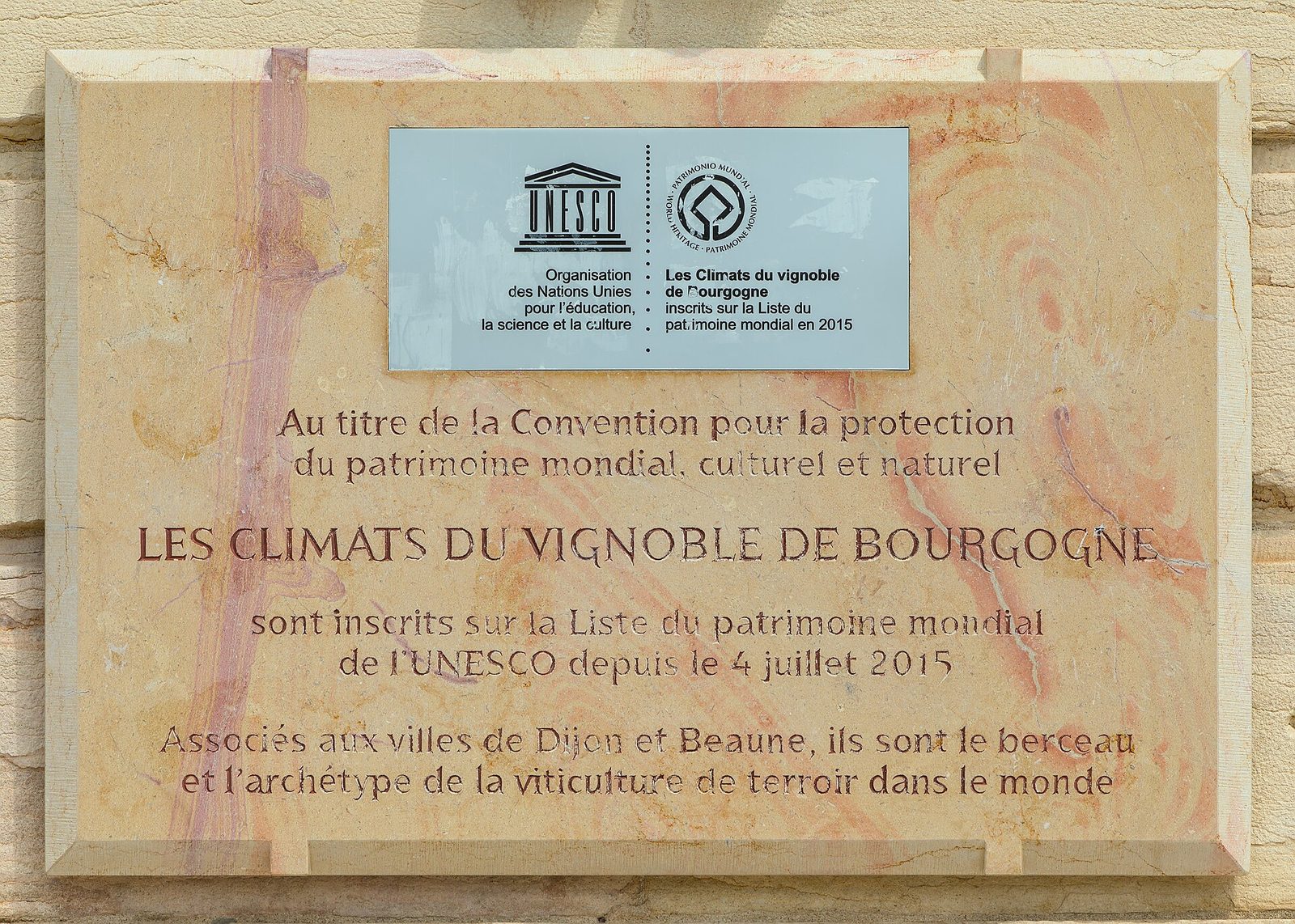
A climat is a precisely bounded, named, legally protected vineyard parcel whose soil, altitude, and sun exposure have been mapped over centuries (many first delineated by Cistercian and Benedictine monks from the 12th century) (source: compass_artifact_wf-5af489e6...). There are 1,247 registered climats; UNESCO confirms they are "precisely delimited," inscribed as a World Heritage Site on 4 July 2015 (the 41st French property) (source).
Many plots are walled enclosures called clos (e.g., Clos de Vougeot, Clos de Tart), and small stone huts called cabottes dot the vines (source).
The four-tier classification
1. Regional (Bourgogne AOC) — ~half of all production; entry level. 2. Village — named for the commune (Gevrey-Chambertin, Pommard, Meursault, Chablis). 3. Premier Cru — ~640 named climat sites (~10% of production); labeled village + climat. 4. Grand Cru — 33 in the Côte d'Or (~1–2% of production), labeled by the climat name alone (Chambertin, Le Montrachet, Corton). Some are monopoles owned by a single producer (e.g., Romanée-Conti and La Tâche, both Domaine de la Romanée-Conti) (source: compass_artifact_wf-5af489e6...).
This contrasts with Alsace's Grand Cru system (51 crus, labeled by grape) — a useful comparison across the wiki's regions.