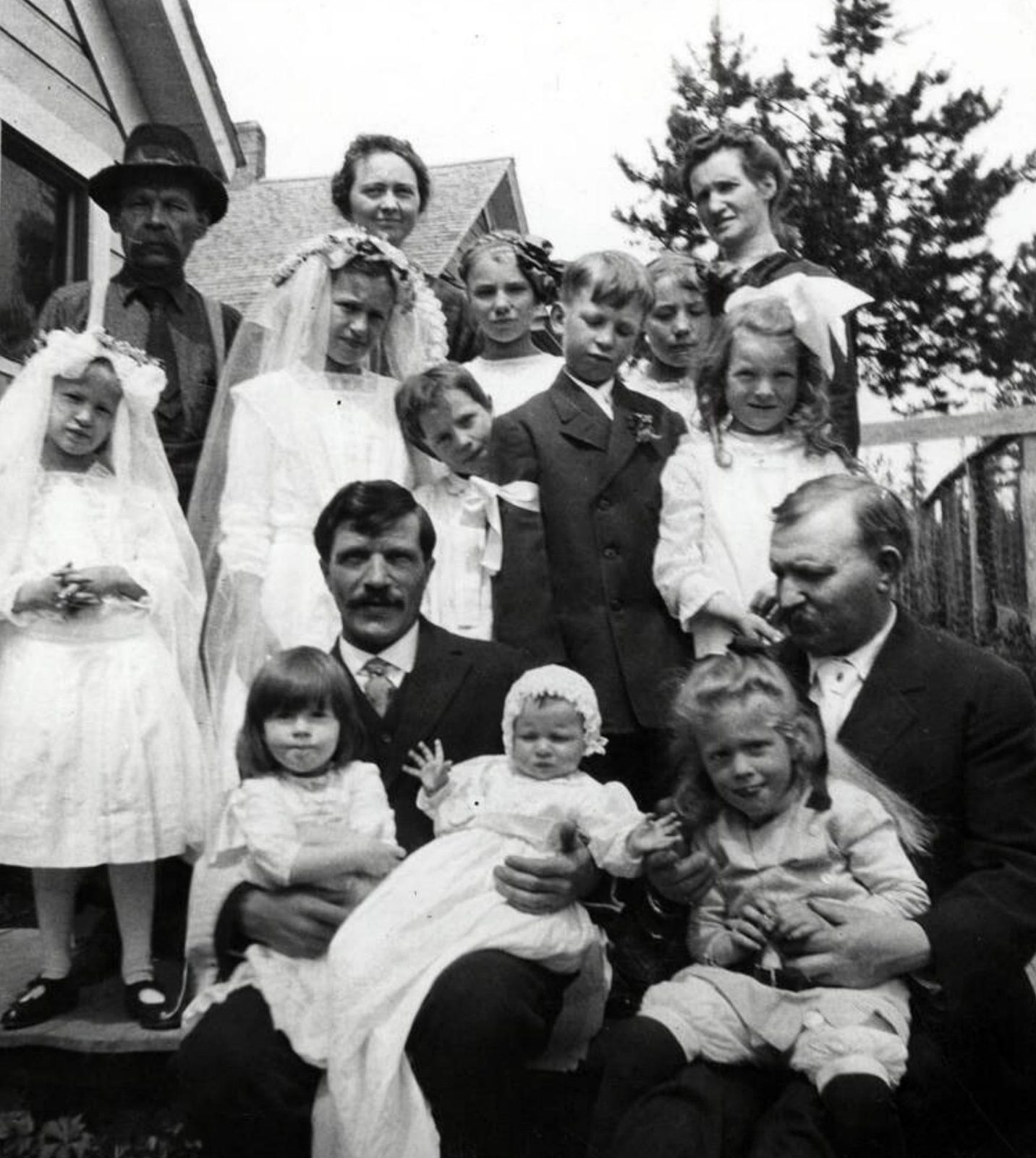
Two sources document Mary's ancestry: Christy's "Return to Roots" research (narrative, photos, primary documents) and the Ancestry "Holley Family Tree" GEDCOM (127 individuals, 37 families — the structured pedigree) (source: Holley-family.pdf; Holley Family Tree.ged). For trip-planning purposes, one ancestral line lands directly on a region this trip already visits, and the deeper German roots fall outside it.
The line that's on the route: Groh / Wohlfrom (Alsace)
Mary's great-grandmother Marie Theresa Groh was born in Marlenheim, Alsace on 8 Dec 1875 (source: Holley Family Tree.ged). (The PDF affectionately calls her "your grandmother," but the pedigree places her as a great-grandmother — see Groh / Wohlfromm Family of Marlenheim.) The family is rooted in the adjacent Bas-Rhin villages of the canton of Molsheim — Marlenheim and Kirchheim (the GED documents five generations there), with Nordheim named alongside them — which Christy's research groups as the "Golden Crown" (Couronne d'Or), with Marlenheim at the very start of the Alsace Wine Route (source: Holley Family Tree.ged; Holley-family.pdf).
This is a direct ancestral pilgrimage that folds into the Alsace leg with no detour — the three villages form the Couronne d'Or ("Golden Crown") cluster. See Groh / Wohlfromm Family of Marlenheim for the full genealogy and the family sites in Marlenheim, Kirchheim, and Nordheim; Mary's Alsace Heritage Research (source summary) for the heritage-travel research (genealogy plan, Le Cerf (Marlenheim), Steinklotz (Grand Cru, Marlenheim), logistics). It is woven into Day 5 of the 12-Day Public-Transit Itinerary: Champagne · Alsace · Burgundy.
The German roots: Alsace-Lorraine + the Zagelow / East Prussia line
Mary's "German heritage" runs through two threads (source: Holley Family Tree.ged):
- Alsatian (on the trip). Alsace was German territory in 1870–71 and again 1940–45 (source: Holley-family.pdf); the Groh records use Kurrent German cursive and the surnames are German. This thread is firmly, documentarily Alsatian.
- The Zagelow thread (probably NOT Alsatian — revised). Marie Groh's husband, Mary's other great-grandfather Herman Zagelow, is recorded as born in "Alsace-Lorraine" (1858) with his father from East Prussia (source: Holley Family Tree.ged). The 2026 heritage report investigates this and concludes the Zagelow line is almost certainly Prussian/Pomeranian, not Alsatian — the surname is a Slavic-German "-ow" name absent from all Bas-Rhin records, the family emigrated to Idaho, and an 1858 "Alsace" birth predates the 1871 annexation, so "Alsace-Lorraine" is most likely an Americanized mislabel (source: mary-heritiage-alsace.md). This corrects the earlier reading that both great-grandparents on this branch were Alsatian. See The Zagelow Branch (genealogical puzzle) for the full reasoning and the US-records-first research path.
- East Prussia (off the trip). Herman's father Frederick William Zagelow was born in East Prussia (~1819) and his mother Louisa Lueck in Germany (~1830) (source: Holley Family Tree.ged) — consistent with the Prussian-origin reading above. East Prussia is today divided between Poland and Russia (Kaliningrad), so it isn't reachable on this France itinerary.
Bottom line: the trip-relevant, documented heritage is the Groh/Wohlfrom line inside the Couronne d'Or; the Zagelow line is a separate, off-trip, US-records-first puzzle that is probably Prussian rather than Alsatian.
The northern-France line: Casteel (Pas-de-Calais / Lille)
On the Holley / Casteel side, an (unvalidated) FamilySearch tree traces descent from du Chastel-de-Blangerval, seigneurs of Blangerval in Pas-de-Calais, northern France, with family places at Lille, Mello, and Toulon-sur-Arroux, plus holdings in Belgium and the Netherlands (source: Holley-family.pdf). This is in the far north of France and is a real detour from the wine regions, but it is reachable from the Champagne end of the trip — see Casteel / du Chastel Family of Blangerval, Blangerval (Blangerval-Blangermont), and Lille.
> Note: This line appears only in the PDF. The Ancestry GEDCOM does not contain it — no du Chastel, Casteel, Blangerval, or Netherlands/Belgium places, and its Archibald branch stops in Ohio (no Scotland). So the medieval northern-France connection rests entirely on the source Christy's research itself flags as unvalidated (source: Holley Family Tree.ged).
Mary's other ancestral lines (off this trip's geography)
These are recorded for completeness; none sit on or near the France → Alsace → Burgundy route. The GED documents several of them in deep detail (source: Holley Family Tree.ged), and the speaker-notes edition of Christy's presentation works each up as a possible standalone heritage trip — primary records plus what-to-see/eat/stay — now given their own pages (source: Holley-family-notes.pdf):
- Rask / Todd — Sweden. Marta Rask, b. 1879 in Forsa, Gävleborg (Hälsingland); orphaned of her mother young, emigrated to Minneapolis in 1893, then Montana and Spokane, where she married the cowboy-turned-railwayman Walter Todd. See Rask / Todd Family — Forsa & Hälsingland, Sweden (source: Holley-family-notes.pdf; Holley Family Tree.ged).
- Noble / Sullivan / Childs — England (& Ireland). William Noble, a coal miner who died in Montana's 1943 Smith Mine disaster, descends from Derbyshire ironstone miners (Wessington, Shirland, Alfreton, Matlock; Greaves of Notts) and Staffordshire Childs (Ipstones); the Sullivan thread runs back through Pennsylvania to Ireland (Cork?). See Noble / Sullivan / Childs Family — Derbyshire & Staffordshire, England (source: Holley-family-notes.pdf; Holley Family Tree.ged).
- Holley / Dougherty — Ireland. Thomas Dougherty, b. 1811 in County Roscommon, emigrated 1844 and settled near Rome, Iowa, where the Holley family married in; full obituaries and a probable Tibohine baptism. See Holley / Dougherty Family — County Roscommon, Ireland (source: Holley-family-notes.pdf; Holley Family Tree.ged).
- Zagelow / Lueck — East Prussia & Germany. See the German-roots section above and The Zagelow Branch (genealogical puzzle); off the trip (now Poland/Russia).
- Casteel / Archibald — only in the PDF/notes. The Belgium/Netherlands (du Chastel) and Scotland (Gargunnock) connections are absent from the GED and rest on an unvalidated FamilySearch tree; see Casteel / du Chastel Family of Blangerval and Holley / Archibald Family — Gargunnock & Stirling, Scotland (source: Holley-family.pdf; Holley-family-notes.pdf).
> Why the family emigrated (Alsatian context from the notes). For the Groh/Zagelow departures around 1884–89, the deck lays out the standard push-and-pull factors: the 1871 German annexation of Alsace-Lorraine (with the 1 Oct 1872 deadline to "opt" for French nationality), conscription pressure on young men facing 2–3 years' German military service, the phylloxera blight (which destroyed ~40% of French vineyards between the 1860s and 1890, squeezing wine-village incomes), and the pull of cheap steamship fares, prepaid tickets and chain migration via Le Havre, Antwerp, Bremen or Hamburg (source: Holley-family-notes.pdf).
Related pages